Sunday, 12 September 2010

Jesus has HIV

I remember my first friend who died of HIV.

He was a small shrivelled man with clunky black glasses through which he looked at me and talked during his last days.

His name was Vanlalringa

I am using a real name for a change. I can't hide my friend's identity with a pseudonym.

I knew Ringa for a few weeks in 1995. It was the first time I really got to know someone living with HIV. Ringa was my first friend to die with HIV.

Ringa was an all out follower of Jesus. He had been to a prestigous Bible college. I won't name it, but when he got sick he had to leave. A past history of drug use caught up to his body. The virus that had entered him so long before was doing its nasty work when I met him. Those were the days before ART was commonly available. Most of what we did was try and deal with opportunistic infections - and try and make things as comfortable as possible.

My memory clouds now 16 years later about when I last met Ringa alive. But I still remember the rainy days I would walk over to his little home. I still remember is small silent mother - and the look of sadness and love on her face as she cared for her seminarian son dying of AIDS.

I remember the funeral wake - locally called a lengkham. After a person dies the house is cleared out of furniture - benches are brought in and the whole community comes to sing songs all night before the funeral. I think it was my first lengkham that I attended. It was the first where I knew the person. I said some few words during the time.

Does Jesus have HIV? He does. His body here on earth - the flesh and blood followers who have been touched by His love have HIV. So many of them. Some like Ringa have already passed on to glory. Others are living through the days and weeks and months and years alloted to them. Many with hope. Many with tears. Many living out the love that their Lord showed to them.

Dan Turello (a good friend of mine who I would love to have living next door instead of in Boston MA) sent me a gentle nudge to look at an article about a South African pastor who preached a sermon called "Jesus had HIV".

I was surprised that people were upset at the statement - specifically because they thought it implied that Jesus slept around.

But look at what Isaiah says about our Lord:

Surely he took up our infirmities
and carried our sorrows,
yet we considered him stricken by God,
smitten by him, and afflicted.

But he was pierced for our transgressions,
he was crushed for our iniquities;
the punishment that brought us peace was upon him,
and by his wounds we are healed. Isaiah 53.3-4

Christians through the ages have been given glimpses into the awesome mystery of the Lord of the universe suffering physically. Some eras saw this clearer than others. With the swirl of antibiotics on one hand and the name-it-claim-it-heal-yourself folks on the other, we in the church seem to have forgotten about Jesus who "surely took up our infirmities." He did not lift them with a forklift and dump them in a trash can. He bore them on Himself. Phillip Yancey footnotes his The Jesus I Never Knew with the statement that some of the Crusaders in the middle ages returned being convinced that Jesus actualy suffered from Leprosy (what we call Hansen's disease today). So much so that those who returned from the holy land with leprosy were considered to have been given the 'holy disease' and looked after in Lazar-houses (named after the beggar Lazarus in the parable Jesus told). One of the German words for 'hospital' - Lazarett - springs from this tradition.

Jesus has HIV not only because His body on earth has it. He also knows the shame and disgust that people treat the disease with. Born of parents who were pregnant when they were married - he knows the scorn of being called a bastard. I had always wondered why a certain band was called Pantera. I now know. Early Greek opponents of the fledgling Christian church (such as the philosopher Celsus) lost no time in painting a scurrilous picture of Jesus' father. They claimed that Jesus was born to Mary after she had an illicit relationship with a wandering Roman soldier named Pantera. His growing up in the small village of Nazareth would have had plenty of opportunities for people to abuse him. All the more likely since we do not hear about Joseph after Jesus' 12th birthday. You can just imagine the talk: "An early death ... what could that mean but God's punishment for a man who sinned?"

Jesus was stripped naked and hung to die by asphixiation on a set of crooked pieces of wood - a curse in Jewish law and an abomenation to everyone who passed. He was spat upon, abused by all and sundry, abandonned and betrayed by his friends. He if anyone knows what suffering is like. He has been through it all.

I don't like pictures of Christ on the cross. Because they are always too Barbie for me. They are too washed-in-Rin-soap safe. They are not the bloodied corpse that still breathed that bore the filth and shame of all my sin upon Him.

Does Jesus have HIV? Yes He does. And everything else that we find loathesome. And more. Much more. HIV would be one of the least of His issues. The true scandal of the ages is that He who knew no sin, who was spotless in this maculate world that He trod - was coated, cloaked, smeared and covered with it. So much so that Father turned away His holy face and prompted Jesus to cry out in the darkness - "My God, My God, why have you forsaken me?"

We have become so sanitized in our faith - so neat, peppy and perky - so spiffy and sparkly that we choose the gloss over the vast tracts of anguish that the good book lays out for us.

The part of Scripture that brought us to the Mumbai area to work with people with HIV was this:

The high priest carries the blood of animals into the Most Holy Place as a sin offering, but the bodies are burned outside the camp. And so Jesus also suffered outside the city gate to make the people holy through his own blood. Let us, then, go to him outside the camp, bearing the disgrace he bore. For here we do not have an enduring city, but we are looking for the city that is to come. Heb. 13.12-14

It struck us that HIV/AIDS was and is a disease linked with shame. There may be many reasons for this - but no matter which society we are in - we see the deep stigma people living with HIV face. God's people are not to shy away from this - but rather embrace it. Our lives should be sharing in the shame of Jesus - the shame and disgrace that every person with HIV is living through in greater and lesser measure as they live through today.

But there is one other thing to remember. Jesus may have HIV now. But He will not be bearing it forever.

Though He did not flinch from suffering. Though He chose willingly to pay the cost for me. Though He expects nothing less from us - and our lives should be marked out with shame and suffering if we are really 'taking up the cross and following Him' - Jesus does not put suffering into a holy box and make a religion out of it.

Instead we look forward to the fulfillment of His kingdom when there will be no more sorrow, no more shame, no more death, no more pain. This is no pie-in-the-sky-in-the-sweet-by-and-by. This is the real hope that each humble follower of Jesus Christ has. Eternal, unending, unbounded, complete, fulfilled, life-as-it-should-be, and life-overflowing-spilling-over-into-forever-and-ever.

If we do look back from whatever time-state eternity is in - we will see that Jesus had HIV - but not-anymore.

My friend Vanlalringa will agree to that. I look forward to talking to him about it - and not having to leave after 1.5 hours like I used to back in Churchandpur, 16 years and a death ago.

Nathaniel

Nathaniel went South. Far South. Almost as South as you can get in India.

His family took him. They wanted him sober. They checked him into a mission hospital with the hope that Nathaniel would stop abusing alcohol.

While at the hospital (which as far as I know is not a rehab centre) he was tested for HIV. He was found to be HIV positive.

We got a call from Nathaniel's doctor - who happens to be a friend of ours. Since Nathaniel lives in Thane, he was referred to us for further treatment - of his HIV that is.

Turns out Nathaniel is more a neighbour than we may have guessed from the phone referral. His father is the chairman of a prominent local church. The family is very afraid that others will find out about his HIV status. They do not want home visits.

About his drinking, however, I am sure most local people will know. It would be unusual if someone who was an alcoholic for over 13 years would escape the notice of people around.

How much the family is co-dependent in this cycle is not clear yet. We are just making contact with them.

His brother and sister brought Nathaniel. He was sullen. We explained about HIV and did a confirmatory HIV test. We talked about deaddiction treatments. We talked about how he needed to bring his wife for testing.

Nathaniel did not come with his wife. She came alone for her test. She looks barely out of school. When we asked about Nathaniel we were told that he was drinking again.

On Saturday Nathaniel came unexpectedly to the clinic. He wanted his wife's report. She had picked up his HIV test - which was positive - and he had come for hers.

By God's grace she is - still - HIV negative.

Now it is Nathaniel's turn to make a change. AIDS kills - but not as quickly as people think. We can drink ourselves to death - but after 13 years of it - the body can manage to chug along pretty well.

It is possible to make a change though - as gloomy as a situation may be.

In talking to Nathaniel, he has at least showed that he is open to be visited at home - something his relatives were dead against. We do know of some of our friends who have been able to get out of the grip of the bottle - and make real changes in their lives.

We are exploring options for places where Nathaniel can go if he is really convinced that he wants to change. But it all turns around the question of whether he can summon up the will to do so. As miserable as his life may be at this point - it has a certain set of sureties. He knows that his family is trying to do something for him. He knows where to get the next shot. He has his pals and the days move forward.

Change is hard.

But change is possible. There is hope. And that's why we are here. Because as long as we have breath there is still hope for change.

We see in the life of Christ that He kept giving second chances to his disciples when they messed up. But we also see the deep sorrow that Jesus had when people walked away from Him. He never forced them to follow Him. But was always willing to give people another opportunity to let them be more like Him.

Say a prayer for Nathaniel. I think we have a long walk ahead with him and his young wife.

Wednesday, 8 September 2010

Vada pav

Tarun's mother has HIV. His father does not. His uncle died of AIDS last year. Its complicated.

Tarun has the disease as well. He is 15 years old and struggling to take TB medications. By God's grace he has completed (with much encouragement) the basic course. We have asked his mother to have him take an additional 2 months of anti-TB meds.

When Sheba wrote out the medication, Tarun's mother asked how much it would cost. The course that he completed was free from the government - but they do not give the extension of treatment.

Sheba said it would be about Rs. 200 or so a month.

"Oh Doctor, don't give cheap medicines, please give something expensive that will make Tarun fully better" said his mother.

Sheba explained that this was the best medicine to take.

Tarun's mother is sad because Tarun is still sick and repeatedly gets diarrhoea.

Sheba talked with Tarun's mother about why this was so.

Tarun's family sell 'Vada Pav' on the roadside. Commonly called 'Bombay Burger' this tasty snack is wolfed down in huge amounts across the city. The potato and gram flour dough - seasoned with mustard and green chillies - is deep fried in oil and the hot round balls are then tucked into the 'Pav' - a Mumbai bun and garnished with more fried chillies and spice.

It tastes great. But is not for the faint of stomache. What actually lurks in the oil is a big mystery. How old the wadas actually are is another. How many flies have sat on them before eating is a third. Whether the cheerful vendour has washed his hands after he last wiped his bum is a fourth. The list goes on.

We strongly suggest that our HIV positive friends do not eat 'anything outside.' With weakened immunities eat stuff like these beloved Bombay Burgers is an invitation to diarrhoea.

Tarun's family makes these tasty treats for a living. They get up at 10 am and work the streets late into the evening - rarely sleeping before 1 AM.

Breakfast for Tarun is a cup of tea and a few biscuits. Lunch and dinner are usually wada pavs.

Sheba sat with Tarun's mother and charted out a diet plan. Chappatis with subji for breakfast. Something nutritious for lunch.

Day before yesterday Tarun came by. He has not grown fat overnight. But he has eaten chappatis after a very long time.

If only getting better was a matter of swallowing expensive medicines. How often we forget the greatest medications given to us. Food.

Tuesday, 7 September 2010

Testing times

This month we did something new. Giri Nayak, our HIV counsellor, attended a meeting held at the government hospital of all the govt. HIV testing centres in the Thane District. He attended it because we are now one of those centres (called ICTCs - integrated counselling and testing centres).

We have been running our ICTC for over a year now. But for most of the time we have been limping along. One month would see 10 people tested. Then another 6. And so it went.

In early August Giri shared these figures with the government official in charge of the centres. He said that we needed to see more people tested.

We agreed.

So during August we ramped up our testing work. We printed a small handbill and had it added to the morning paper runs in some key neighbourhoods. We gave handbills to autorickshaw drivers. We held an awareness and testing camp with BIDS - a local NGO. We had Naveen visit local medical stores and doctors and tell about our programme. Naveen and Nimit also visited a local industrial area and talked to workers there.

The numbers of people being tested increased. On the 31st of August I asked Giri how many people had been tested so far.

He said 35 had been tested.

I was a tad dissappointed as we had put ourselves a mental target of seeing 50 people tested.

Wouldn't it be nice, I thought, if we could at least make it to 40?

I asked the Peter to spare the home-based care team at lunch - and requested that they make a short outreach programme to the industrial area. Who knows - maybe we will reach 40! We prayed.

Later in the afternoon I came to the centre and saw chappals lined up outside the door. I walked in to see young men whom I had not seen before. In the lab a row of test-tubes stood - each labelled and containing a blood sample. There were 11 test-tubes of blood. We cracked 40 - and ended up with 46 people tested during August!

Why is it important to get numbers?

One is for credibility with the government. We know that we are doing good work - but it is important to be partners in the continuum of health. If for some reason we have to shut shop tomorrow, we do not want our friends to be treatment orphans. We are working towards becoming a partner in ART therapy with the government - and the succesful running of a testing and counselling centre is a first step towards this.

Another is because when we test people - they have a chance. A chance to change. A chance to face up to reality. A chance to take charge of their lives. And the more people at risk (which is a very very large number) who are tested - the more options they have.

For every 'negative' result we get - we let out a happy sigh of relief. But it is so important that the young man or woman understand that they now need to see real changes in their behaviours or we will not be giving a happy sigh anymore. HIV infection is like a light switch - its either 'on' or 'off'. There is no inbetween. And once its 'on' - there is no 'off' left. The switch is stuck permanently 'on.'

For those with HIV. We are glad that we can test them here. And then be able to directly counsel them about fighting the infection - and prolonging their lives. We are glad that it is us talking to them - though it is hard for us to share the news - rather that them getting the result in some little lab where the technician just gives them a slip of paper with 'HIV antibody reactive' printed on it.

And so we plunge into September. Will we be able to test more people than the 46 that we did in August?

We hope so.

Sunday, 5 September 2010

single-day seminary sojourn

Its not often that I get to visit seminaries. But the visit at the end of August to the Union Biblical Seminary in Pune was special.

Special in part - because it gave Lun and I amazing glimpses of God's grandeur in the lush monsoonal landscape between Thane and Pune.

Looking out of the train window gave us visual treats like this:

I am always glad to see paddy sown - it means golden harvests later when the rich husks of rice are cut and the farmer rejoices in the yield. For a hungry land we need these harvests so much - and when the monsoons are good (like they are this year in our area) it is a cause for joy!

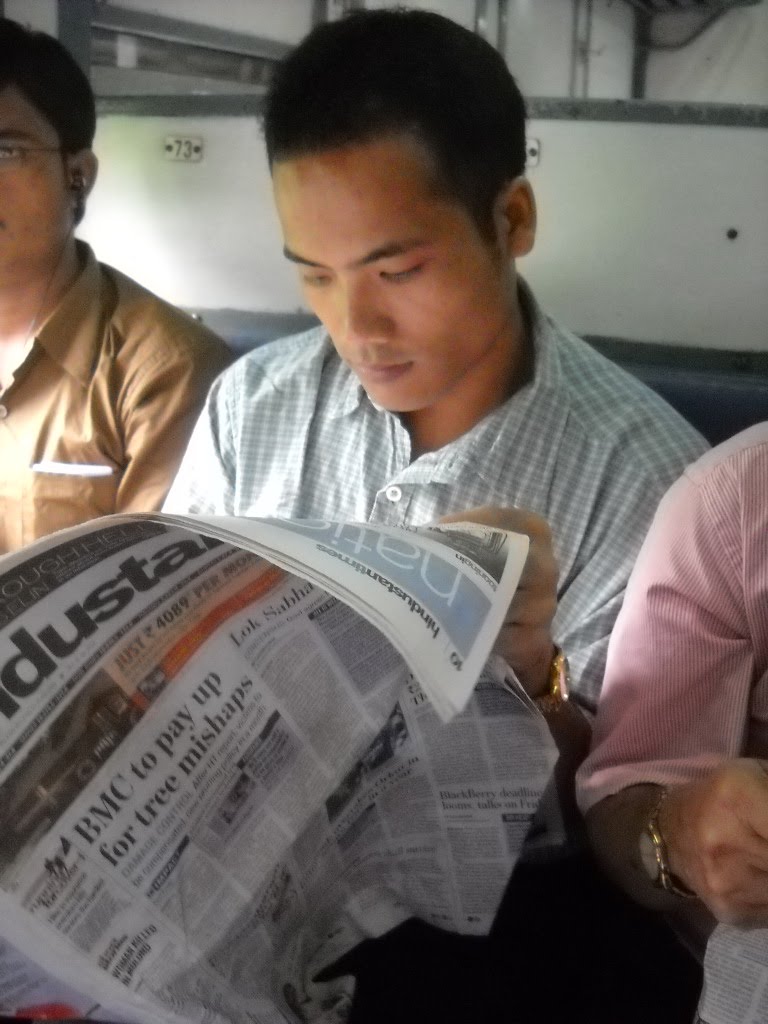
A few minutes later we were climbing the Western Ghats. Lun - one of this year's UBS interns (and who is from Manipur) was buried for some time in the paper catching up to the daily happenings.

Later we had an animated conversation with a retired bank manager who now travels the world and had a goodly stock of opinions (sample: Moses, Abraham and Ibrahim are the founders of the three main religions - but why are the followers fighting with each other?).

Outside the scenery continued to stun:

Check out the monkey on the right side of the frame - neither he nor I knew that he was in the picture when it was clicked.

The monsoons do such magic to the hills. What is dry and brown come alive with greenery and waterfalls.

A sight for sore urban eyes like those in the sockets of yours trully. I just couldn't stop myself from exclaiming at the sheer beauty of it all.


The main purpose for the visit to UBS was to talk in a special Current Concerns chapel in the afternoon about HIV/AIDS in India and what work we are doing at Jeevan Sahara Kendra.

I had had minimum sleep the night before in preparation for the day - but it was all worth it.


We were greeted by the three interns who had been with us last year - John Jeebaseelan, Binson James and Ashis Karthak. What a joy to see these wonderful men again. It really warmed the cockles of my heart to see their enthusiasm and the love that they poured on us to make sure that our time was as comfortable as could be.

We were joined at lunch by Rev. Premanand Bagh - the coordinator of the internship programme. It was also good to meet students who are looking into working with us next year for their 7 months practical training.

The chapel was a great opportunity to meet with the students and staff and share our heart. I talked about the scenario of HIV in our country and what Jeevan Sahara is doing. Lun shared about the experiences of working as an intern at JSK.

The talk was well received with good questions afterwards. The conversations that were started continued over tea (bless the Lord for that wonderful drink). It was heartening to meet pastors in training who really seem interested in having their churches a places where people with HIV are loved and in speaking out to help prevent the further spread of HIV.


Lun and I left the greenery of UBS in particular and Pune in general - to come back to the greyness of Thane - grateful for the opportunity to meet some wonderful people - and challenged to keep going forward!

Trafficking

Late Sunday afternoon lethargy. We tried to visit a family - but found out that tomorrow is better.

What to do together?

Asha says: "Lets read a book or see a movie that we have not seen."

Things click in this Daddy's mind. Maybe the time is now to unveil what has been hidden for some time...

Down comes a DVD which had been purchased a few weeks prior. A condensed - but still very watchable version of Herge's classic Tintin adventure The Red Sea Sharks.

I had not read the comic for years - and so was pleasantly surprised. Herge tells a cracking good yarn - I now remember why this was a favourite for me - given the prominence of the Mosquito fighters and the action invovled. But Herge also weaves in his old special brand of slap-stick with a virtual rogues gallery of past 'baddies' showing up (Allen, Rastapolous, Mueller and more) as well as our beloved incompetents (the Thom(p)son twins, Nestor, Castafiore, Alcazar and Haddock of course).

What surprsed me was the nature of the adventure. It is about human trafficking - in the book mainly black Africans (if my memory is correct) - in the film there seem to be a variety of folk (including Desi looking types) who are being smuggled for immigration purposes.

People are not for selling - but they continue to be smuggled - with various levels of connivance - and deep pockets who are making profits from the horrible business of slavery.

The fact that the story ends in the comforts of Marlinspike (and the Emir safely back in the saddle) doesn't mean that this is the situation for most people who are being trafficked today.

Our friends in programmes who are involved with rescue and restoration of girls sold into prostitution (like Freedom Firm, Oasis India Trust and IJM) know how difficult it is - and how costly and heartbreaking the process of rehabilitation can be.

After the excitement and glamour of 'rescuing' the girls from the brothel - comes the years of work of walking along side these young women and helping them blossom into the women that God has created them to be. The long-term carers are few. The funds meagre. The challenges great. So much more needs to be done.

Hats off to the few who are making a difference though.

Bread and circuses

They brought in the child.

He was 7 - maybe 8.

They were a group of muscly men. All clad in identical t-shirts. "There is nothing wrong with him" - they said "only a small cut."

Sheba looked at the child lying on the bed. He was dazed. The boy had been climbing up one of the human pyramids that characterise the festival celebrating the birth of Krishna.

The pyramid had collapsed. He was crushed in the melee.

Our staff were passing the spot and said that the men had not paid attention to the boy. The music had started again and the men began dancing with abandon. Unsurprisingly, the men who came in reeked with alcohol.

The staff had brought the boy in. Sheba checked his hands and torso for injuries. There did not seem to be any. "Does it hurt here?" she asked, softly pressing different parts of the boys body. "No" came the soft reply. The eyes looked vacant.

The boy seemed to have escaped serious trauma to his body. There was a small cut on his foot which was dressed by our nurse.

There was not much else to do but release the boy.

He was swallowed up into the afternoon.

-------------------------
Later that night I had to do some shopping. The cross roads near our house was a mass of humanity. Truck loads of teams coming and going - aiming to build the pyramid and smash the pot of dahi - and collect a large cash prize in the process. Hundreds of people looked on eagerly at the spectacle as a massive sound system growled out hybrid twitchy beats.

All around were immense hoardings - of the local political party that was organsing the show in this pocket. Advertisements of the local sweet shop and other local businesses also featured prominently - with more surface area devoted to them than to the diety for whom the festival is held. The other money - money that had been extracted out of countless local folks - big and small - by the 'volunteers' did not get mention - other than the obvious costs incurred in putting the spectacle together. As before - electricity comes free from the power grid - its the local godfather who is organising the spectacle after all.

As I passed a token policeman did some traffic directing - a truckload of pyramid climbers was just pushing off - while others were coming in. Buses and cars which had been waiting to pass inched by.

I was struck by the masses of young men - wearing T-shirts with a prominent regional politician on the front - and a local politico on the back - driving scores of motor cycles festooned with their party flags.

There is so much energy and potential in these young men. But 2 days after the spectacle is over - the pot-holed roads and gloomy monsoonal skies have hardly a memory of them.

Would that we could see each young man doing daring things that have long-lasting fruit. The bread and circuses that our local parties vie in out-doing each other in (which are far less bread and far more circus of course) are not in any way building our country.

As for the boy. May he fare well. Will he grow up to be one of the reeking men who 'accompanied' him to our clinic. Remember that each one of them used to be a small boy of 7 or 8 years of age.